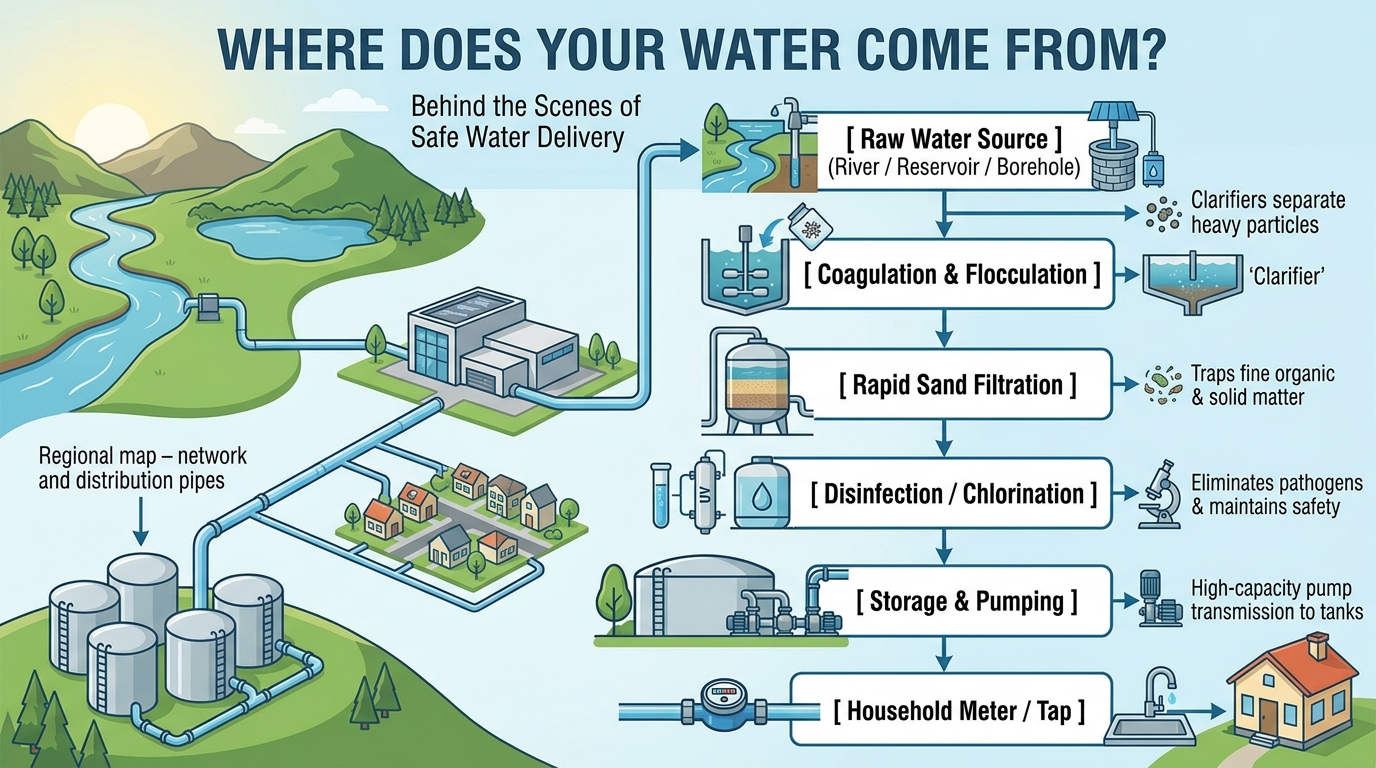
urn on a tap in your home or business, and clean water flows out almost instantly. It is a simple daily moment that easy to take for granted. Yet behind every drop is a continuous, 24/7 cycle of engineering, water testing, and careful distribution governed by national safety standards set by WASREB and KEBS.
Understanding where your water originates—and the care required to make it potable—reveals why protecting our water networks is a shared responsibility.
Phase 1: Abstraction & Source Protection
Our water journey begins at local river catchments, dams, and deep aquifers. Raw water is harvested through intake structures designed to manage silt and debris. Because raw river water contains natural sediments, bacteria, and agricultural runoff, it cannot go directly into supply mains without intensive treatment.
Phase 2: Treatment & Purification
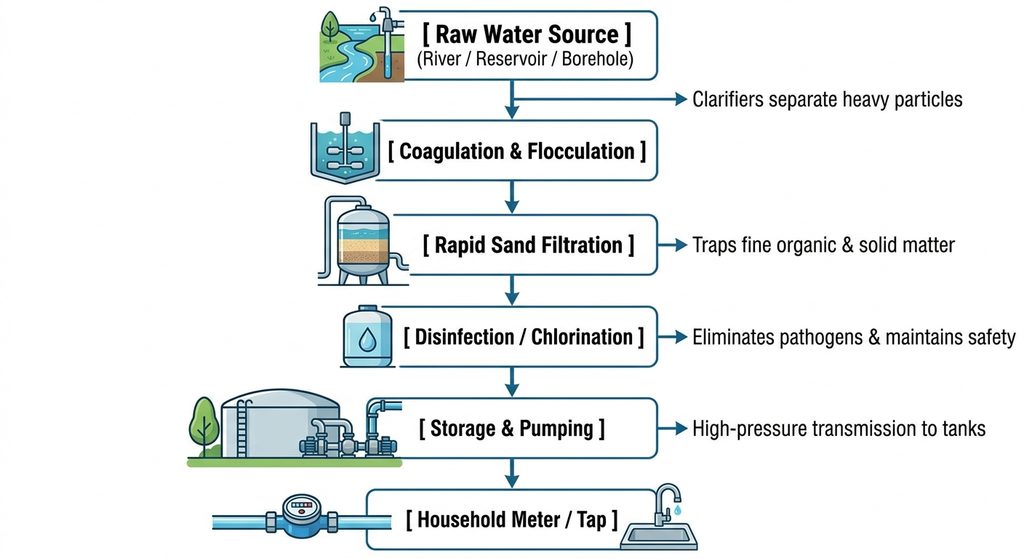
At our water treatment works, raw water undergoes a multi-stage purification process:
- Coagulation & Flocculation: Safe chemical agents (such as alum) are introduced to gather microscopic dirt particles into larger clusters (“flocs”).
- Sedimentation: The water flows into large clarifiers where heavy particles settle to the bottom, leaving clear water on top.
- Sand Filtration: Water passes through layers of graded sand and gravel to trap remaining microscopic impurities.
- Disinfection: Precise dosages of chlorine eliminate harmful pathogens and bacteria. A residual chlorine level is maintained throughout the distribution grid to ensure water stays sterile inside the pipe network.
- Quality Testing: Laboratory technicians run hourly checks measuring pH, turbidity, chlorine levels, and microbiological safety.
Phase 3: Pumping & Network Distribution
Once treated, water is pumped to elevated storage reservoirs located at strategic high points across the service region. Gravity then carries water through hundreds of kilometers of transmission mains and local feeder pipes into your neighborhood meter.
What You Can Do
- Protect Water Sources: Avoid dumping waste or farming along riparian zones near rivers and catchment areas.
- Report Main Bursts Immediately: If you see water spraying along roadsides or leaking from large pipes, report it to our customer care team right away. Quick repairs save millions of liters of treated water.
Leave A Comment